OUR SERVICES

Clinical/Pharmacy Softwares

Patient records, pharmacy inventory, and billing that meet healthcare compliance requirements from day one.

Clinical/Pharmacy Softwares icon Backed by 12+ years of hands-on delivery experience
Contact Us About This Service
Clinical/Pharmacy Softwares
1+
Systems Deployed
1K+
Patient Records Managed
1%
Uptime
1%
Compliance Ready

OUR EXPERTISE

Healthcare Software Expertise

Patient Records Systems
1%
Pharmacy Inventory
1%
Billing & Claims
1%
Data Security & Compliance
1%

ABOUT THIS SERVICE

Everything Clinical/Pharmacy Softwares Covers

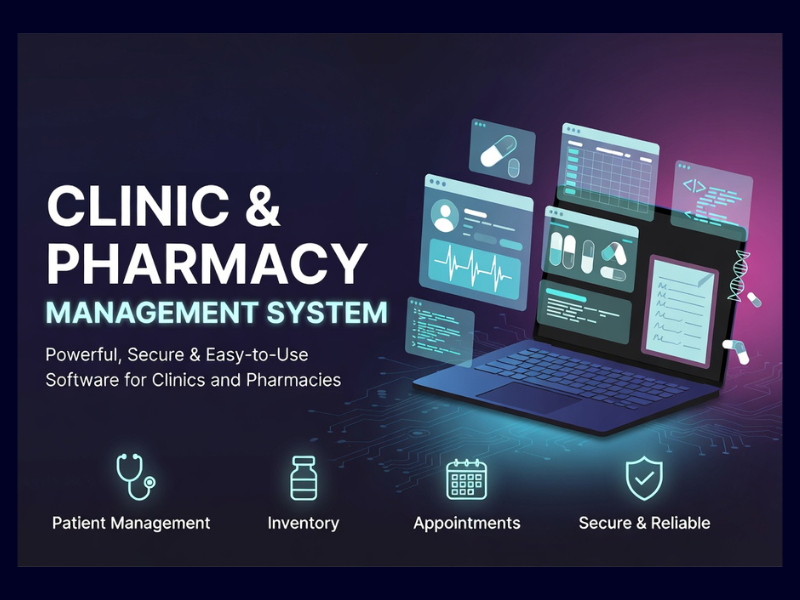
Clinic and pharmacy management software built for patient records, inventory, and billing in one system, instead of three disconnected registers.

Healthcare and pharmacy operations need software that keeps patient history, prescriptions, stock levels, and billing accurate and in sync — a missed update in any one of those creates real problems. We build clinic management systems and pharmacy software around your actual patient flow and compliance needs.

  • Patient records and appointment scheduling
  • Pharmacy inventory and prescription tracking
  • Billing and insurance/claims support
  • Multi-user access for doctors, staff, and pharmacists
Clinical/Pharmacy Softwares illustration

CLIENT FEEDBACK

What It's Like Working With Us

Patient lookup that used to take minutes now takes seconds.

Dr. Sana Malik

Clinic Director, Private Practice

Stock reconciliation errors basically disappeared after we switched over.

Farrukh B.

Pharmacy Owner, Retail Pharmacy Chain

Data security was handled properly from the first conversation, not bolted on later.

Dr. Ali Hassan

Medical Director, Diagnostic Lab

Billing and claims sync across all three branches without manual double-entry now.

Kiran F.

Practice Manager, Multi-Location Clinic

Illustrative examples — reach out for references from recent clients.

READY TO START?

Let's Talk About Clinical/Pharmacy Softwares.

Tell us your goals and we'll get back to you within 24 hours with a clear next step — no obligation.

FAQS

Secure Healthcare Solutions Built for Precision and Care

Clinical and pharmacy software covers electronic health/medical records (EHR/EMR), appointment and patient management, prescription and dispensing workflows, and inventory tracking for medication — built around patient safety and data security as non-negotiable requirements, not optional features. This category carries a materially higher bar for compliance and testing than most other software categories, since errors have direct patient-safety consequences rather than just business inconvenience. NextStep treats security and compliance review as a mandatory phase of every healthcare project, not a step that can be compressed to hit a launch date.

EHR/EMR (Electronic Health/Medical Record) software manages patient clinical history, diagnoses, and treatment across a practice or hospital; pharmacy management software manages medication inventory, dispensing, and prescription fulfillment specifically, and the two need to communicate with each other (a prescription written in the EHR has to reach the pharmacy system accurately) even though they're often separate platforms. A clinic needs EHR software; a pharmacy needs dispensing and inventory software; a hospital or health network with both typically needs the two systems integrated rather than a single one trying to do both jobs adequately. NextStep builds both and treats the integration between them as an explicit requirement, not an afterthought.

Yes, for any clinical or pharmacy software handling US patient data — HIPAA requires safeguards around how patient health information is stored, transmitted, and accessed, including encryption, access controls and audit logging, and formal agreements with any vendor that touches that data. Compliance has to be designed into the system's architecture from the start (data encryption, access permissions, audit trails) — it's not something that can be bolted onto a finished system afterward without significant rework. NextStep builds US healthcare projects around HIPAA requirements from the initial architecture stage, and can provide the technical documentation a covered client's compliance team will need to review.

Interoperability is the ability for different healthcare systems to exchange patient data accurately with each other, and HL7 and its modern successor FHIR are the standard formats that make that exchange possible — without them, patient data gets siloed in one system and has to be manually re-entered anywhere else it's needed, which is both inefficient and a real source of clinical error. A clinic or pharmacy evaluating new software should ask directly whether it supports these standards, since a system that can't exchange data with labs, hospitals, or insurance systems will eventually need a costly integration project to fix that gap. NextStep builds interoperability into clinical and pharmacy platforms as a baseline requirement rather than a premium add-on, since it's foundational to the software actually working within a wider healthcare system.

Existing EHR platforms are faster to deploy and come with established compliance certifications already in place, making them the sensible choice for a standard practice with typical workflows; custom software earns its cost when a clinic's specialty, patient volume, or workflow genuinely doesn't fit what commercial platforms offer, or when per-provider licensing costs from commercial EHRs become expensive at scale. A useful middle path many clinics choose is a certified commercial EHR core with custom modules built around its specific gaps, rather than replacing the whole system. NextStep will recommend this honestly based on a clinic's actual specialty and scale, rather than defaulting every healthcare inquiry to either extreme.